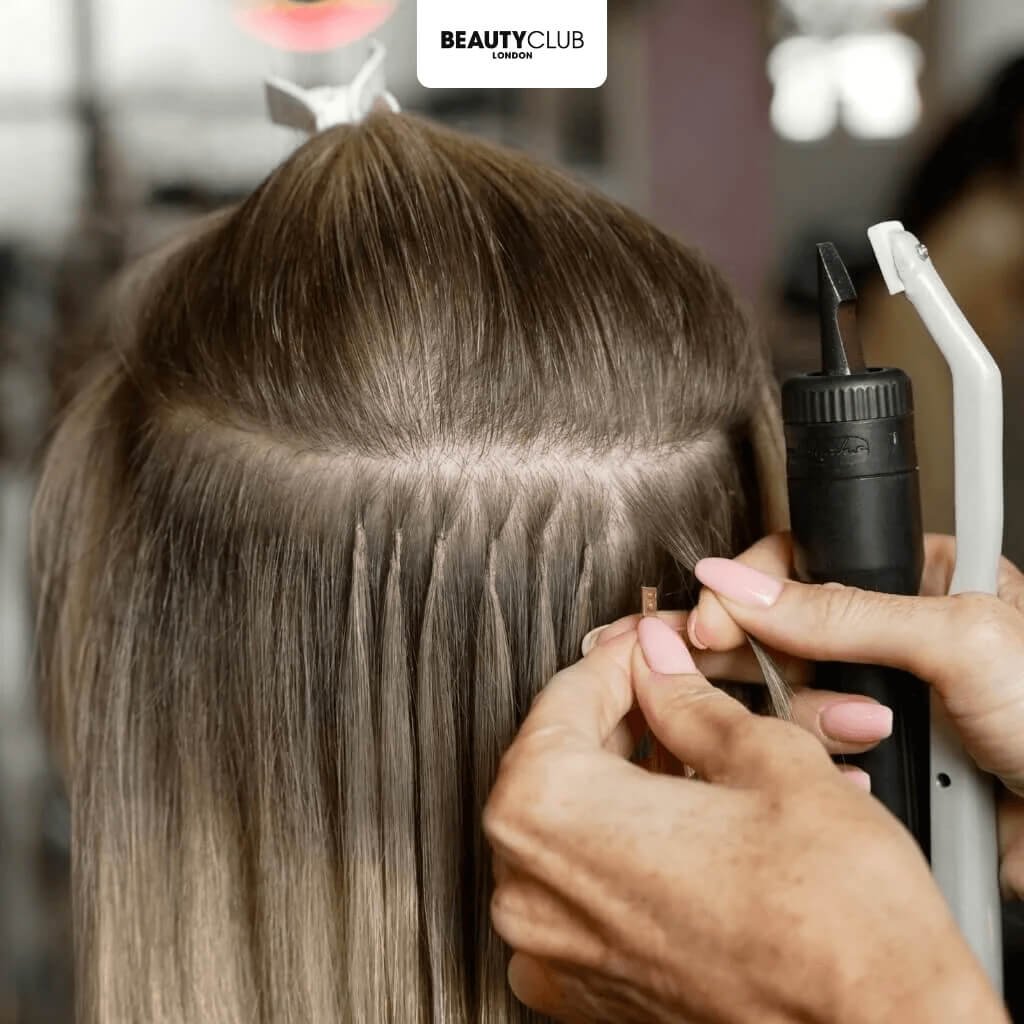
Hair extensions don’t damage your hair when they’re fitted correctly. Damage happens when one of four things goes wrong:
- The wrong method is fitted to the wrong hair type
- The extensions are fitted incorrectly
- A low-quality product is used
- Aftercare or maintenance is neglected
When all four are properly considered, extensions can actually protect natural hair rather than damage it. Most people overstyle and overwash flat hair to bring volume back, and both habits cause breakage over time. Extensions hold a style for several days, which gives the hair underneath a real break from heat and friction.
How Hair Extensions Can Damage Your Hair
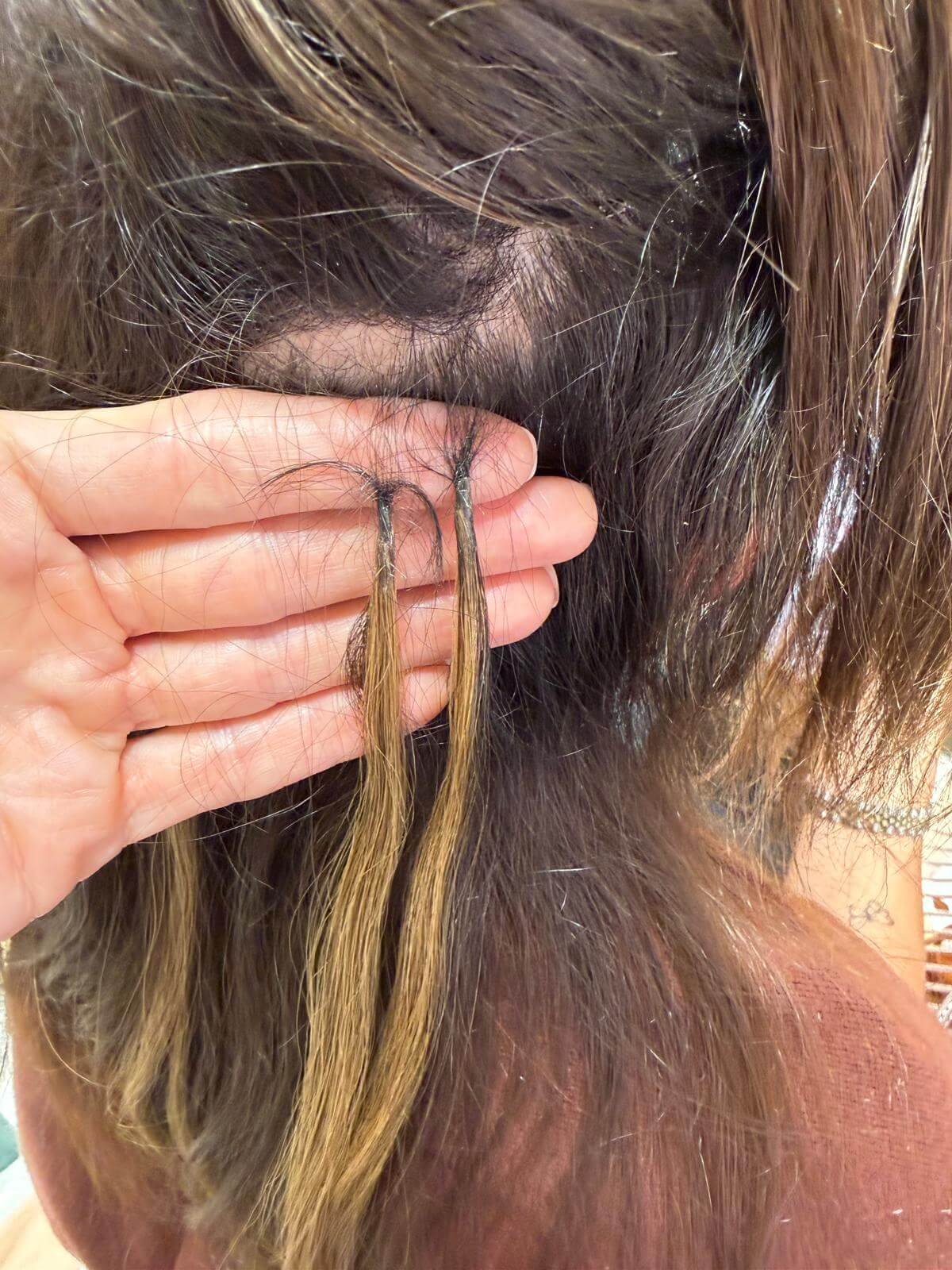
The image above shows a client who came to us with hair extension damage caused by unskilled application, something we help clients recover from regularly at Beauty Club London. The natural hair has snapped on either side of the small section supporting the bond, caused by poor sectioning and uneven tension during fitting. Once that initial breakage happens, the bond starts to twist against the remaining hair, and it’s that twisting which does the real damage. The uneven weight pulls on fewer and fewer strands until the hair snaps off completely and leaves short stumps behind.
Over the course of a year of repeated applications like this, a client can lose significant amounts of their natural hair. The good news is that damage like this is almost always preventable, and tends to come down to four causes:
1. Wrong method for the hair type
Single-bonded methods on fine hair, or a full head of extensions when the natural hair doesn’t have the density to support them, are two of the most common mismatches we see. The fix is honest assessment up front: a good specialist should look at your hair density, length, and condition before suggesting a method, and should be willing to recommend a different option (or no extensions at all) if your hair isn’t a good fit for what you’ve asked for.
2. Incorrect fitting or DIY removal
Extensions placed too close to the scalp, fitted with too much tension, or applied without proper sectioning all place excessive strain on the hair, which leads to breakage and shedding. Pulling extensions out at home is just as damaging, and it’s one of the fastest ways to lose your own natural hair along with them. Always go back to your stylist for removal or refitting.
3. Low-quality product
Not all hair extensions are created equally. Synthetic hair paired with cheap tape adhesive can irritate the scalp, harsh clips put more pressure on the natural hair, and lower-grade keratin bonds twist more easily and leave residue behind on removal. Always look for human hair extensions with attachment points specifically formulated to protect the health of your natural hair.
4. Aftercare and maintenance gaps
Sleeping on wet extensions, brushing roughly, using shampoos that contain sulphates, and using hot tools without protection are the most common aftercare mistakes. Maintenance matters just as much: when extensions are first fitted, the section of natural hair sitting above each attachment point is short, which keeps the extensions stable and stops them from twisting. As your hair grows, that section lengthens, and the longer it becomes the more freely the extension is able to move and twist with daily wear. That twisting places tension on your hair from unnatural angles, and it’s one of the most common causes of damage we see in clients who push their refits too far.
Sticking to the maintenance window your stylist gives you keeps your extensions in the safe zone, and the refit itself moves each attachment point back to a stable position. Our full hair extensions aftercare routine walks through every step.
The good news across all four is the same: extension damage can be avoided when the right precautions are in place from the start.
Are Hair Extensions Bad for Your Hair?
Hair extensions are not bad for your hair when they’re fitted correctly. The single most useful concept to understand is weight distribution: the ratio of extension hair to natural hair at each attachment point. The wider the attachment, the more natural hair supports the weight of the extension, and the lower the risk of damage. A 30-40mm tape weft spreads the weight across a wide section of natural hair, keeping the ratio within a safe range. A 3-5mm bond, like the ones shown in the image earlier, is much smaller, with far less natural hair supporting it, which is why damage in those cases tends to look like the breakage and thinning in the photograph.
The reason this question gets so confused is that “hair extensions” is an umbrella term covering seven main methods, each of which works in a completely different way and carries a different level of risk.
Saying extensions damage hair is a bit like saying shoes hurt your feet. It depends on which shoes, how well they fit, and what you’re doing in them.
Will Hair Extensions Ruin Your Hair Permanently?
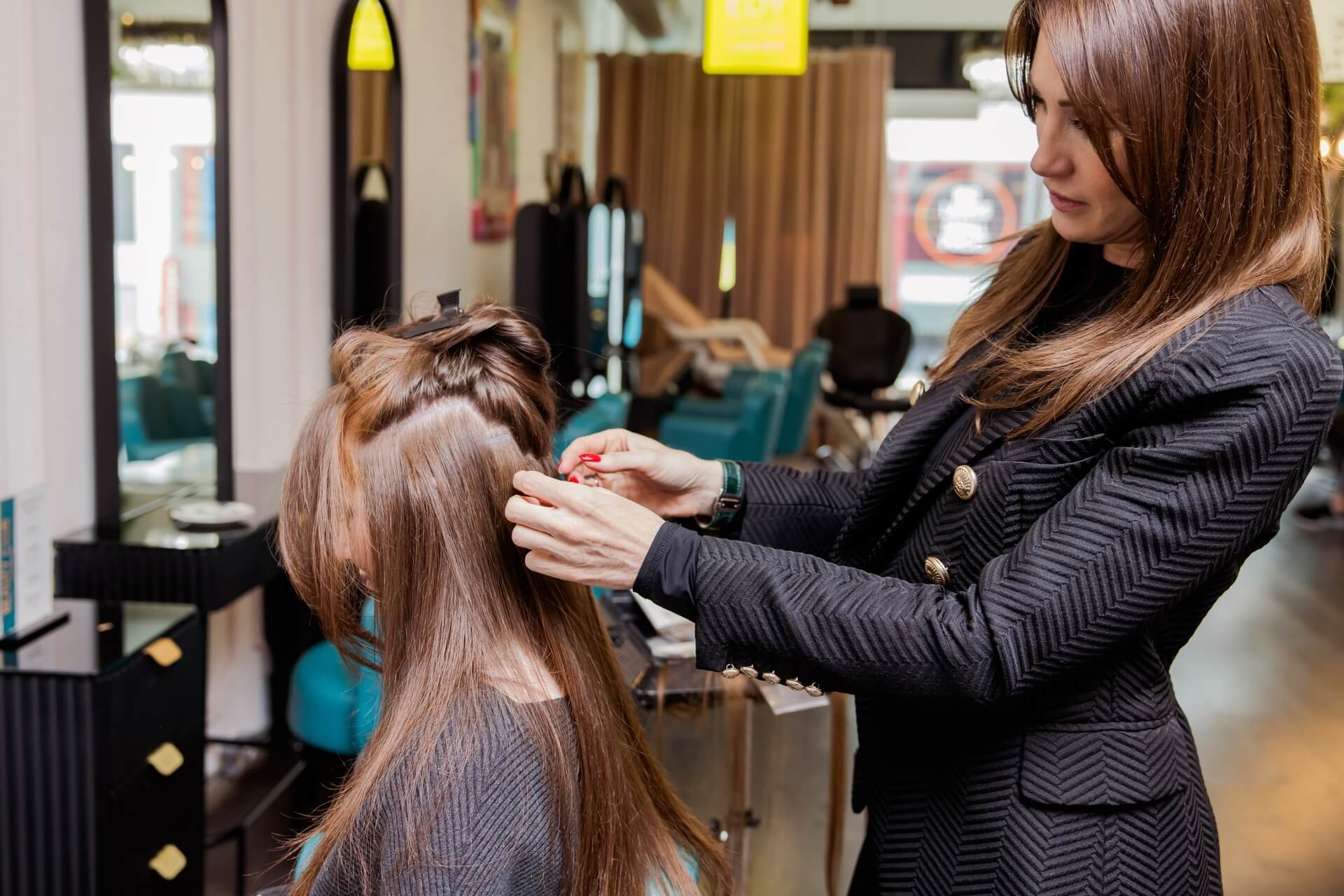
In most cases, no. Most extension-related damage is reversible once the underlying cause is fixed. We work with clients regularly to recover from damage caused by incorrectly fitted extensions elsewhere, and most see significant improvement within three to six months once we’ve fitted them correctly with the right method, product, and aftercare routine for their hair.
The exception is traction alopecia, a form of hair loss caused by sustained pulling on the hair. The British Association of Dermatologists names hair extensions among the styling practices that can lead to it. Caught early, traction alopecia is reversible. Left for too long, it isn’t. That’s the strongest argument for choosing a method that doesn’t pull constantly on your roots, and for working with a specialist who will tell you honestly when extensions aren’t the right call.
Do Tape Extensions Damage Your Hair?

Tape-in extensions are one of the lowest-risk semi-permanent methods when they’re fitted by a specialist and refitted on schedule.
Standard tape wefts are around 30-40mm wide, which means the weight of the added hair is spread across a much bigger section of your natural hair than any single-bond method can manage. The application uses no heat, no metal, and on high-quality extensions, a medical-grade adhesive that releases cleanly with the right solution.
Tape-ins can still cause damage when:
- They’re placed too close to the scalp, leaving no room for natural movement.
- They’re fitted to unsectioned hair, causing it to twist against the extension.
- The refit is left too long, allowing the weight to redistribute onto less natural hair.
- They’re removed at home with the wrong product, ripping the natural hair out with the tape.
When clients come to us with tape-related damage, the cause is almost always one of those four things, not the method itself. With a refit every six to eight weeks and a careful aftercare routine, the natural hair underneath stays healthy, and many clients wear tape-ins continuously for years. For more on the refit window and lifespan, see our guide on how long tape in extensions last.
Do Micro Ring Extensions Damage Your Hair?
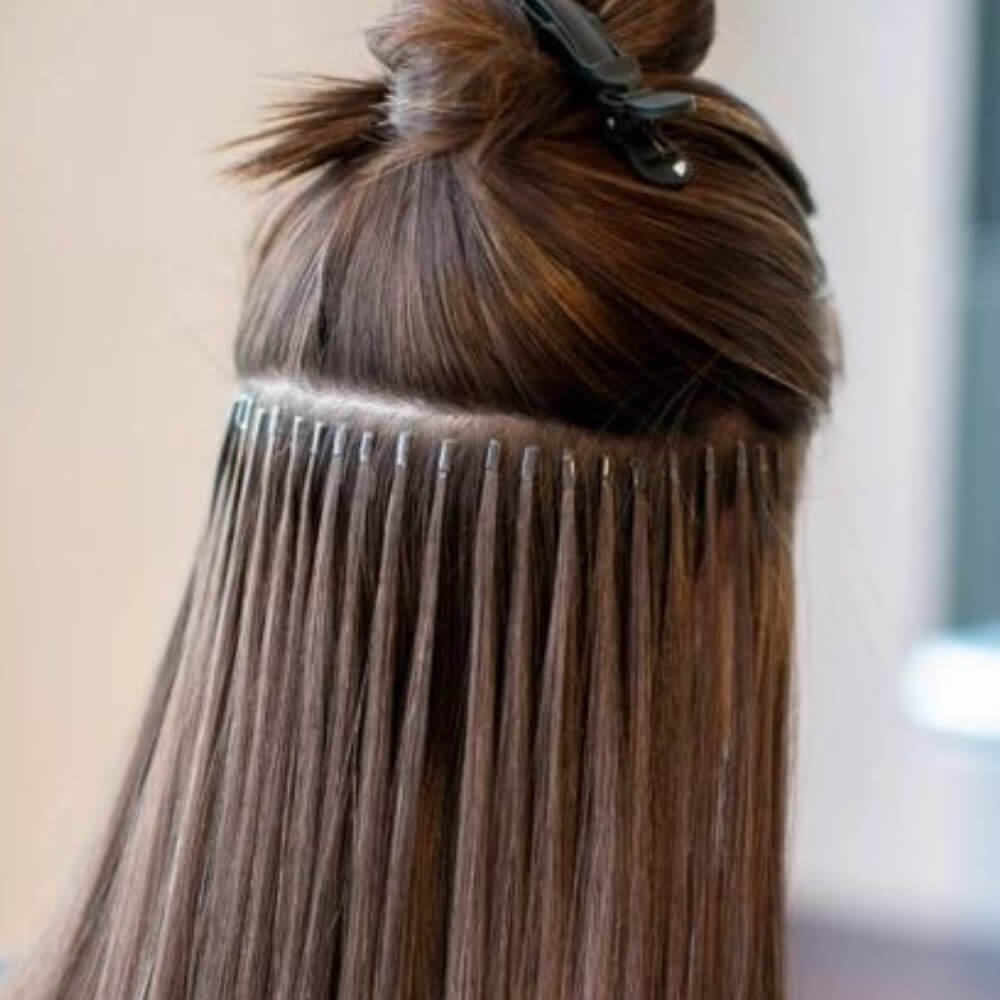
Micro rings carry a higher risk than other methods, particularly on fine or thinning hair. This is where our advice diverges from a lot of guides online. We help women recover from extension damage regularly at Beauty Club London, and micro rings are involved more often than any other method, so it’s worth explaining why.
A micro ring (or its smaller version, the nano ring) is a metal bead around 3-5mm wide that clamps a section of extension hair to a small section of your natural hair. The attachment point is small and discreet, which is why they’re often recommended on fine hair.
The trade-off is weight distribution. Compared to a 30-40mm tape weft, the full weight of a micro ring sits on a much smaller attachment point, with far less natural hair supporting it. The smaller area is also more prone to twisting under daily movement, which is one of the main ways these methods cause damage. The risks compound when the fitting isn’t done correctly or a refit is missed, and the damage usually shows up as breakage along the rows of hair the rings were attached to, or as thinner patches underneath where they sat.
Do Bonded Extensions Damage Your Hair?
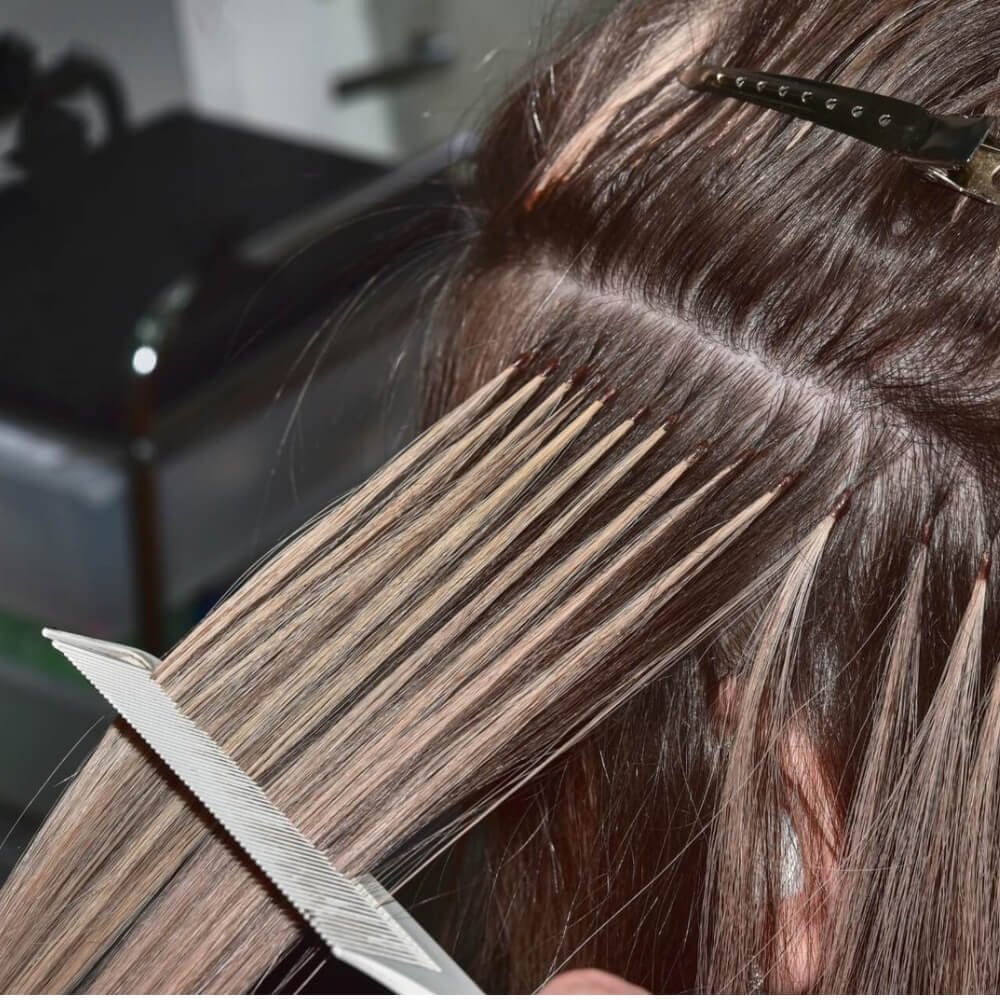
Bonded extensions can be safely worn on healthy, full-density hair, provided the method, product, application, and aftercare are all properly considered. The attachment point is small, the application uses hot or cold fusion, and the weight concentrates onto a small section of natural hair rather than spreading across a wider weft, all of which makes them less suitable for fine or thinning hair.
A keratin-tipped section of extension hair is fused to a small section of your natural hair using either hot fusion (direct heat from a heated tool) or cold fusion (ultrasonic vibration that softens the keratin without applying heat to the hair). Removal involves a solvent that breaks down the keratin so the extension can be slid free.
On healthy, dense hair, bonded extensions can deliver excellent results, including long-lasting wear and a discreet attachment that’s easy to blend. The two main concerns when the hair is finer or thinner are the heat used during application (in the case of hot fusion), which can weaken the surrounding hair, and the concentrated weight on a small attachment point. With bonded extensions, you need to be especially careful about heat exposure during styling, regular maintenance, and gentle removal to ensure your natural hair stays healthy. For fine or thinning hair, we’ll usually recommend tape-ins instead. Our hair extensions for thin hair guide covers exactly why in more detail.
Do Clip-In Extensions Damage Your Hair?
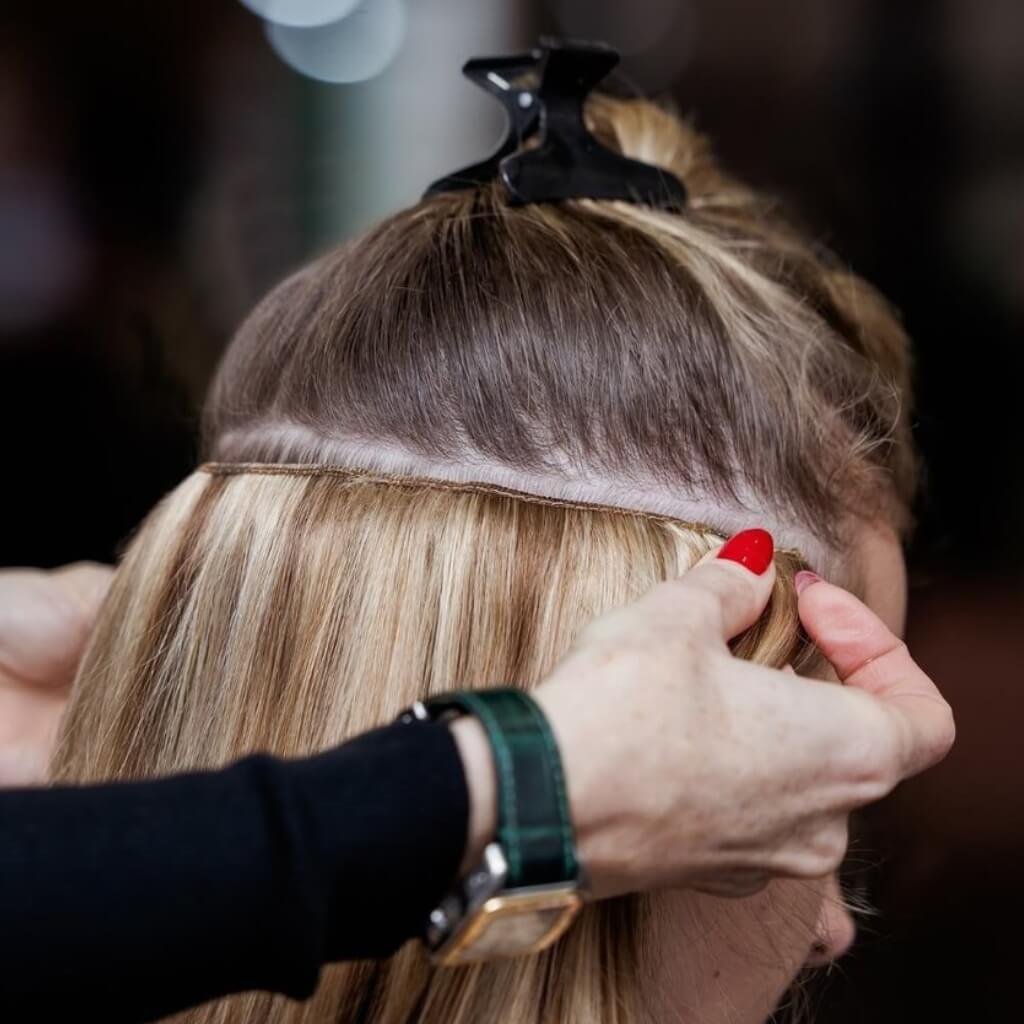
Clip-ins can be worn safely with very low risk to the natural hair, provided they’re put in and handled with care.
There’s no adhesive, no heat, and no continuous tension on your natural hair. You put them in for the day, take them out at night, and your natural hair gets the same overnight rest it would have without them.
Clip-ins can still cause damage when:
- Sleeping in them. The clips are small and rigid, and rolling around on them all night will pull at the natural hair where they’re attached.
- Wearing the same clip in the same spot every day. Over months, the same point of pressure can thin the hair underneath. Move the clips around between wears.
- Pulling them out. The clips are designed to release with a gentle pinch and slide free without resistance. Tugging risks pulling the natural hair out with the clip.
- Heavy wefts on finer hair. Clip-in sets that are too dense for the natural hair to comfortably support will pull on the clip points throughout the day, often leading to scalp soreness and breakage where the clips were placed, which is why getting advice from a specialist is important before fitting.
For occasional wear, special events, or anyone testing whether extensions suit them, clip-ins are the easiest way in. For more on what to expect day-to-day, see our guide: are hair extensions comfortable?
Warning Signs Your Extensions Are Causing Damage
If you’re already wearing extensions and want to know whether they’re affecting your natural hair, these are the signs to watch for.
Persistent tightness or headaches. Depending on the method, a new set may feel slightly tight for a day or two while you get used to the new hair, but the discomfort should ease quickly. Tightness that lasts beyond the first few days, or headaches that came on after fitting, means the application is too tight. Don’t wait, go back to your stylist.
Matting or tangles at the roots. A small amount of shed hair gathering at the attachment points is normal. Solid mats or felted-feeling sections aren’t, and they often signal an overdue refit, incorrect application or product build-up.
Unusual shedding when you wash. Some shedding is unavoidable and isn’t a sign of damage. Suddenly seeing significantly more hair than before, especially with broken-off short ends, should be checked by a specialist salon.
Visible thinning around the parting or hairline. If you can see a band of shorter hair appearing along where the attachment points sat, that’s breakage from concentrated tension. The fix is usually switching method or finding a more experienced stylist, not stopping extensions altogether.
An itchy or sore scalp. Some itchiness in the first week can be normal, especially for clients with sensitive scalps. Persistent soreness can mean the attachment points are too tight, the products are reacting with your scalp, or there’s build-up. Our guide on itchy hair extensions walks through the most common causes.
If any of these appear, the answer is the same: get a specialist to look at them as soon as possible. That might be the stylist who fitted them if the issue is something straightforward, or someone with more experience if the original fitting is part of the problem. Never try to remove or refit extensions yourself. If you’ve spotted one or more of these signs in your own hair, the good news is that caught early, these issues are fixable.
How to Wear Extensions Without Damaging Your Hair

Most of the work of keeping your natural hair healthy under extensions is done at home. The non-negotiables:
- Brush from the ends upwards with a soft-bristle extension brush, supporting the attachment points with your other hand. The how to brush hair extensions guide covers the technique in detail.
- Use a sulphate-free, alcohol-free shampoo and conditioner. Sulphates strip moisture and weaken the attachments. Our shampoo for hair extensions guide is the simplest place to start.
- Don’t sleep on wet hair, and tie or plait loosely before bed. The how to sleep with hair extensions guide explains the technique.
- Use heat protection every time you reach for a hot tool, and keep direct heat off the attachment points.
- Protect your hair on holiday. Chlorine and saltwater dry out both your natural hair and the extension hair, and sun exposure adds to that. Our hair extensions on holiday guide covers this in depth and gives practical solutions.
- Stick to your stylist’s maintenance schedule. Refit windows vary by method, but skipping or stretching them is one of the most common ways damage starts.
The list above covers the highest-priority steps. For the rest of the routine, see our complete extensions aftercare guide.
Considering Hair Extensions? Get a Specialist’s Opinion First
The most useful thing you can do is sit down with an experienced stylist who will look at your natural hair, ask the right questions, and tell you honestly which method (if any) suits you.
Many of our clients travel from across the UK and internationally to see us, but if you’re choosing a salon closer to home, here’s what to look for: experience in your specific method, before-and-afters of clients with hair similar to yours, and an honest answer about what they’d do if your hair wasn’t ready for extensions yet.
Frequently Asked Questions
Do hair extensions hurt your hair?
Hair extensions shouldn’t hurt your hair. The pain people sometimes report comes from extensions fitted too tightly, placed too close to the scalp, or applied in a method that puts too much weight on fine hair. Depending on the method, you might feel a new set slightly for a day or two, but anything more than that means something needs adjusting and you should go back to your stylist for a checkup.
Can hair extensions cause hair loss?
In rare cases, yes. This is almost always the result of incorrectly fitted extensions or low-quality products that pull on the natural hair too aggressively. The condition this causes is called traction alopecia. Caught early, it reverses once the cause is removed. Left for too long, the affected area may not grow back. It’s entirely avoidable when the method suits your hair, the products are high quality, and the specialist fitting them knows how to spot the early warning signs.
What are the safest hair extensions?
Tape-in extensions are the safest option for hair health. They spread the weight of the added hair across a wide section of natural hair, sit flat against the head, and require no heat during application, all of which makes them the gentlest semi-permanent method available.